
Beginner’s Guide to Prompt Writing
If you’ve just started using ChatGPT, you’ve probably noticed something interesting: two people can ask about the same topic and receive completely different answers. The difference isn’t luck. It’s the prompt.
A prompt is the instruction you give ChatGPT. It tells the AI what you want, how you want it, and sometimes even who the answer is for. Learning how to write effective prompts is one of the fastest ways to improve the quality of your conversations with AI.
The good news is that you don’t need to be a programmer or an AI expert to write great prompts. With a few simple techniques, anyone can create prompts that produce clearer, more accurate, and more useful responses.
This beginner’s guide will teach you everything you need to know to start writing prompts that work.
What You’ll Learn
In this guide, you’ll discover:
- What a prompt is
- Why prompt writing matters
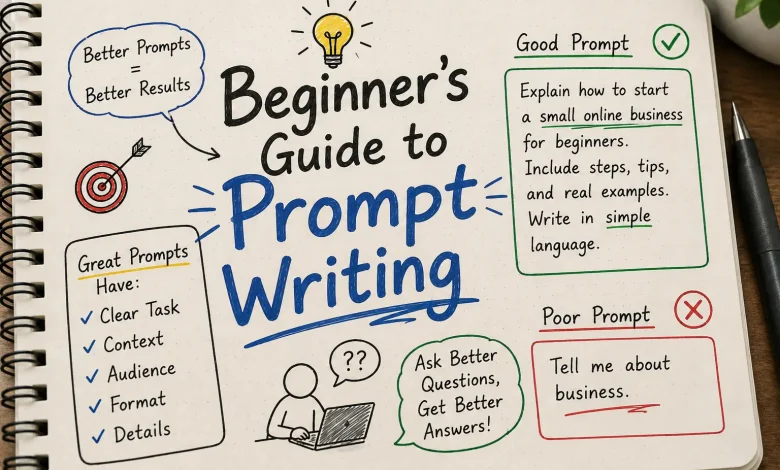
- The essential parts of a good prompt
- Different types of prompts
- Common mistakes beginners make
- Simple prompt templates you can use immediately
What Is a Prompt?
A prompt is simply the message or instruction you give ChatGPT.
Think of it as giving directions to a helpful assistant.
For example:
Basic Prompt
Explain climate change.
Better Prompt
Explain climate change to a 12-year-old using simple language and everyday examples.
Both prompts ask about the same topic, but the second one gives ChatGPT more direction.
Why Prompt Writing Matters
Imagine asking a chef:
Cook something.
You might get anything.
Now imagine saying:
Cook a healthy vegetarian dinner for two people in under 30 minutes using ingredients commonly found at home.
The second request is much more useful because it includes details.
Prompt writing works the same way. The more relevant information you provide, the better ChatGPT can tailor its response.
The Anatomy of a Great Prompt
Most effective prompts include these five elements.
1. The Task
Start by telling ChatGPT what you want it to do.
Examples:
- Explain
- Write
- Summarize
- Translate
- Compare
- Brainstorm
- Create
- Analyze
Example:
Write a blog post.
2. The Topic
Clearly describe what the prompt is about.
Example:
Write a blog post about beginner-friendly gardening tips.
3. The Audience
Tell ChatGPT who the content is for.
Examples:
- Beginners
- Students
- Business owners
- Parents
- Developers
- Teachers
Example:
Write for complete beginners.
4. The Format
Choose how you want the answer presented.
Examples:
- List
- Table
- Step-by-step guide
- Blog post
- Checklist
- FAQ
- Summary
Example:
Present the answer as a numbered guide.
5. Additional Instructions
Add helpful details like:
- Word count
- Tone
- Reading level
- Examples
- Practical tips
- Actionable advice
Example:
Use simple English and include three real-world examples.
Types of Prompts
Informational Prompts
These help you learn something.
Example:
Explain how solar panels generate electricity.
Creative Prompts
Used for writing and brainstorming.
Example:
Write a mystery story set in an abandoned lighthouse.
Instructional Prompts
These ask ChatGPT to teach a process.
Example:
Show me how to create a monthly budget in Excel.
Analytical Prompts
Used for comparisons or evaluations.
Example:
Compare electric vehicles and hybrid vehicles.
Problem-Solving Prompts
Designed to help find solutions.
Example:
My website traffic has dropped by 40%. Suggest possible reasons and ways to recover.
The Simple Prompt Formula
A useful structure for beginners is:
Task + Topic + Context + Format + Extra Instructions
For example:
Create a beginner-friendly workout plan for someone who wants to lose weight at home. Present it as a seven-day schedule and explain each exercise in simple language.
This formula works for almost every type of request.
Before and After Examples
Example 1
Poor Prompt
Help me with business.
Better Prompt
Create a simple business plan for a home bakery selling custom cakes in Chicago. Include startup costs, pricing, and marketing ideas.
Example 2
Poor Prompt
Write an article.
Better Prompt
Write a 2,000-word beginner’s guide about home composting. Include headings, practical tips, common mistakes, and a FAQ section.
Example 3
Poor Prompt
Teach me coding.
Better Prompt
Teach me Python programming from scratch using simple explanations and one practical example in each lesson.
Common Prompt Writing Mistakes
Being Too Short
Very short prompts often lead to generic answers.
Instead of:
Explain SEO.
Try:
Explain SEO for someone starting a personal blog with no previous experience.
Giving Too Little Context
Always explain your situation if it affects the answer.
Instead of:
Recommend software.
Use:
Recommend free project management software for a five-person marketing team.
Combining Too Many Requests
Avoid asking ChatGPT to complete many unrelated tasks in one prompt.
Instead of:
Write a blog, create social media posts, design an email campaign, and generate keywords.
Ask one task at a time or break a large project into smaller prompts.
Not Refining the Conversation
Prompt writing is a conversation, not a one-time command.
Follow-up prompts such as:
- Expand section two.
- Give more examples.
- Make it simpler.
- Add a comparison table.
- Rewrite for professionals.
can dramatically improve the final result.
Prompt Templates for Beginners
Learning Template
Explain [topic] as if I’m a complete beginner. Use simple language, practical examples, and a short summary.
Writing Template
Write a [content type] about [topic] for [audience]. Use a friendly tone, headings, and practical examples.
Business Template
Act as a business consultant and help me create a plan for [business idea]. Include risks, opportunities, and actionable recommendations.
Marketing Template
Create a marketing strategy for [business]. Include content ideas, social media suggestions, and email campaign recommendations.
Coding Template
Explain how to build [project] using [programming language]. Provide step-by-step instructions with code examples.
Tips for Better Prompt Writing
- Be specific about your request.
- Give enough context.
- Mention who the content is for.
- Ask for the format you want.
- Include any limits, such as word count or tone.
- Refine the response with follow-up questions instead of starting over.
- Experiment with different wording to see what works best.
Frequently Asked Questions
Do I need long prompts?
No. A prompt should include enough detail to guide the AI, but it doesn’t need to be unnecessarily long.
Can I improve an answer after ChatGPT responds?
Yes. One of the biggest advantages of ChatGPT is that you can ask follow-up questions to refine the response until it meets your needs.
Should I always include context?
Whenever your situation affects the answer, providing context usually leads to more relevant and personalized responses.
Is prompt writing difficult?
Not at all. Like any skill, it improves with practice. Starting with a simple structure and refining your prompts over time is often enough to achieve excellent results.
What’s the biggest mistake beginners make?
The most common mistake is asking vague questions without explaining what they actually want. Clear instructions almost always produce better results.
Final Thoughts
Prompt writing is the foundation of using ChatGPT effectively. The better your prompts, the better your results. By learning to define your task, add context, specify the audience, choose a format, and include helpful instructions, you’ll get more accurate, useful, and actionable responses.
Remember that prompt writing is a skill that improves with practice. Don’t be afraid to experiment, ask follow-up questions, and refine your requests. Over time, you’ll develop a style that consistently produces high-quality answers.
Secondary Keywords:
- ChatGPT prompt writing
- Prompt engineering for beginners
- How to write ChatGPT prompts
- AI prompt writing guide
- Prompt writing examples