
When most people start using crypto, they buy and sell through a centralized exchange.
These platforms act as middlemen and manage your transactions.
But Web3 introduced a different approach.
Decentralized exchanges, commonly called DEXs.
A DEX allows users to trade cryptocurrencies directly from their wallets without relying on a central company.
This is one of the biggest innovations in decentralized finance.
What Is a DEX in Simple Terms
A DEX is a decentralized exchange that lets users swap cryptocurrencies directly with each other.
Instead of depositing your funds into a company-controlled account, you keep full control of your assets.
Your wallet connects directly to the platform.
Trades happen through smart contracts.
No bank.
No broker.
No middleman.
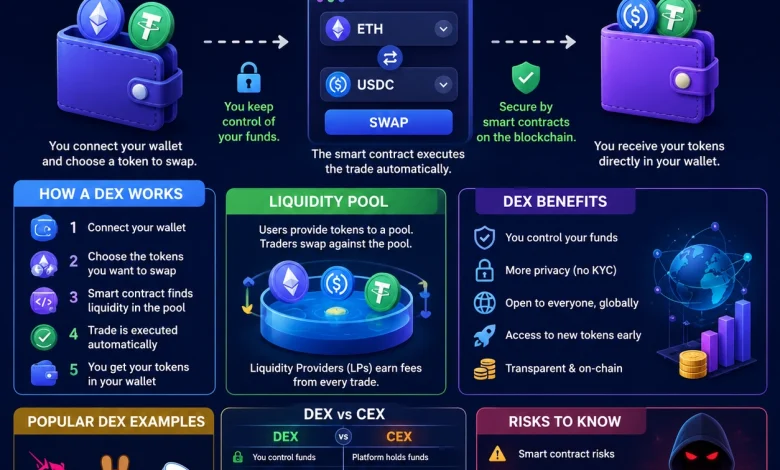
How a DEX Works
A DEX uses smart contracts and liquidity pools to process transactions.
Here is the basic process
- Connect your wallet such as MetaMask
- Choose the token you want to swap
- Select the token you want to receive
- Confirm the transaction
- The smart contract executes the trade
The assets move directly between blockchain addresses.
What Is a Liquidity Pool
Liquidity pools are what make DEXs work.
A liquidity pool is a collection of tokens locked inside a smart contract.
These tokens are supplied by users known as liquidity providers.
When someone wants to trade, the DEX uses the pool instead of matching buyers and sellers directly.
This allows trading to happen instantly.
Why DEXs Are Important
DEXs give users complete control over their funds.
In traditional exchanges
The company holds your assets.
With a DEX
You control your wallet and private keys.
This aligns with one of the main goals of Web3.
Ownership and decentralization.
Benefits of Using a DEX
Full Control of Assets
Your funds stay in your wallet.
You do not need to trust a company with custody.
Privacy
Most DEXs do not require identity verification.
You simply connect your wallet and trade.
Global Access
Anyone with an internet connection and a crypto wallet can use a DEX.
Access to New Tokens
Many new tokens appear on DEXs before they are listed on major exchanges.
Popular DEX Examples
Some well-known decentralized exchanges include
- Uniswap
- PancakeSwap
- SushiSwap
These platforms allow users to swap tokens directly from their wallets.
DEX vs Centralized Exchange
Let’s compare them.
Centralized Exchange
The platform holds your funds.
Examples include traditional crypto trading companies.
Advantages
- Easy for beginners
- Customer support
- Simple interface
Disadvantages
- Less privacy
- Custody risks
- Account restrictions
Decentralized Exchange
You control your assets.
Advantages
- Greater privacy
- Full ownership
- Access to new projects
Disadvantages
- More responsibility
- Requires basic Web3 knowledge
- No customer support if mistakes happen
Risks of Using a DEX
While DEXs are powerful, users should understand the risks.
Fake Tokens
Anyone can create a token.
Always verify official contract addresses.
Smart Contract Risks
Bugs or vulnerabilities can affect platforms.
Slippage
Large trades can affect prices.
This may result in receiving less than expected.
User Error
Sending assets to the wrong address can lead to permanent loss.
How DEXs Connect to Airdrops
DEXs are one of the most common places where airdrop opportunities begin.
Projects often reward users who
Trade tokens
Provide liquidity
Use the platform early
Remain active over time
Many of the largest airdrops in crypto history were distributed to active DEX users.
This is why experienced airdrop hunters regularly interact with decentralized exchanges.
How to Use a DEX Safely
Follow these simple rules
Use official websites only
Verify token contract addresses
Start with small transactions
Keep your seed phrase secure
Double-check every transaction before approving it
Simple Example
Imagine you have ETH and want USDC.
On a centralized exchange
You send funds to the platform and place an order.
On a DEX
You connect your wallet and swap directly.
The smart contract handles everything automatically.
No middleman is involved.
Common Beginner Mistakes
Many beginners
Connect wallets to fake websites
Trade unknown tokens without research
Ignore transaction fees
Approve suspicious smart contracts
Learning basic security practices can prevent most problems.
Final Thoughts
DEXs are one of the foundations of Web3.
They allow people to trade directly from their wallets without giving control to a central company.
While they require some learning, they offer greater freedom, privacy, and access to opportunities.
For anyone exploring DeFi and airdrops, understanding DEXs is essential.
Quick Summary
A DEX is a decentralized exchange
It allows users to trade directly from their wallets
DEXs use smart contracts and liquidity pools
Users maintain full control of their assets
DEX activity can help qualify for future airdrops