

Smart contracts are one of the most important ideas in Web3, but they are often explained in a way that feels too technical.
Let’s simplify it.
A smart contract is simply a piece of code that runs automatically on a blockchain when certain conditions are met.
Instead of relying on a middleman like a bank, lawyer, or platform, the agreement is handled by code.
If the conditions are met, the action happens. If not, nothing happens.
That’s it.
But behind that simple idea is something very powerful.
What Is a Smart Contract in Simple Terms
Think of a smart contract like a vending machine.
You insert money and select a product.
If the correct amount is paid, the machine automatically gives you the item.
There is no human involved. No negotiation. No delay.
The rules are already programmed.
Smart contracts work the same way.
They follow a simple logic
If this happens, then do that
For example
If user sends 1 ETH, then send them a token
Once deployed on the blockchain, this process runs automatically.
Where Smart Contracts Run
Smart contracts run on blockchains such as Ethereum.
These blockchains support programmable code, which allows developers to create decentralized applications.
Once a smart contract is deployed, it cannot easily be changed. It becomes part of the blockchain.
This makes it transparent and trustworthy because anyone can verify how it works.
How Smart Contracts Work Step by Step
Let’s break it down in a simple flow
- A developer writes the smart contract code
- The contract is deployed to the blockchain
- Users interact with the contract using a wallet like MetaMask
- The contract checks the conditions
- If conditions are met, it executes automatically
No manual approval is needed.
No delays.
No middleman.
Real Life Examples of Smart Contracts
Smart contracts are already used in many areas of Web3.
Here are a few examples
Sending Payments
A smart contract can automatically send funds when a condition is met.
Example
If a freelancer completes a task, payment is released instantly.
Airdrops
Many airdrops are powered by smart contracts.
If you meet the requirements such as interacting with a platform, the contract distributes tokens to your wallet.
Decentralized Exchanges
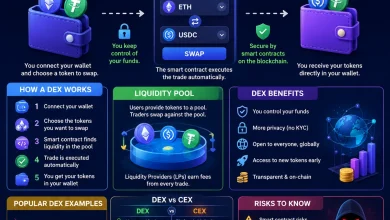
On decentralized exchanges, smart contracts handle trades.
When you swap tokens, the contract executes the trade without needing a central authority.
NFTs
Smart contracts manage ownership of NFTs.
They track who owns what and ensure transfers are secure.
Key Features of Smart Contracts
Smart contracts have several important features that make them powerful.
Automation
Everything runs automatically once conditions are met.
Transparency
Anyone can view the contract code on the blockchain.
Security
Because they run on blockchain, they are difficult to tamper with.
Trustless System
You don’t need to trust a person or company.
You only need to trust the code.
Benefits of Smart Contracts
Smart contracts offer several advantages compared to traditional systems.
No Middleman
You don’t need banks, agents, or third parties.
Faster Transactions
Processes that normally take days can happen instantly.
Lower Costs
No intermediaries means fewer fees.
Global Access
Anyone with internet access can use smart contracts.
Limitations of Smart Contracts
Smart contracts are powerful, but they are not perfect.
Code Errors
If the code has a bug, it can be exploited.
No Flexibility
Once deployed, it is hard to change.
Requires Knowledge
Beginners may find it difficult to understand at first.
Why Smart Contracts Matter in Web3
Smart contracts are the foundation of Web3.
They power
Decentralized finance
NFTs
Airdrops
Decentralized applications
Without smart contracts, Web3 would not exist.
They remove the need for centralized control and give users more power.
How Smart Contracts Connect to Airdrops
If you are interested in airdrops, smart contracts are very important.
Here is how they are used
Projects create smart contracts that track user activity.
When conditions are met such as completing tasks or interacting with a platform, the contract distributes rewards.
This means
No manual distribution
No favoritism
No delays
Everything is handled automatically.
Simple Analogy to Remember
If you forget everything, remember this
A smart contract is like a robot that follows instructions.
It does exactly what it is programmed to do.
Nothing more, nothing less.
Final Thoughts
Smart contracts may sound technical, but the idea is simple.
They are automated agreements that run on blockchain without the need for trust or middlemen.
As Web3 grows, smart contracts will continue to power more applications and opportunities.
Understanding them gives you a strong foundation in crypto.
Quick Summary
Smart contracts are programs that run on blockchain
They execute automatically when conditions are met
They remove the need for middlemen
They power DeFi, NFTs, and airdrops
They are secure but require careful coding